

Overview
Every case study we have published so far leaned on scale: hundreds of placements, compounding month after month. This one is the opposite, and that is exactly why we are sharing it.
A regulated-products e-commerce brand came to us in February 2026 with declining traffic and a problem most agencies will not touch: publishers are cautious about its niche, link opportunities are scarce, and strict compliance rules govern every pitch. Over the next six months we built a total of 35 editorial links. Organic traffic grew 324%, from 1,061 to around 4,500 visits a month.
That works out to roughly 100 new monthly visits earned per link built. When volume is off the table, quality carries the entire campaign, and this is what that looks like.
To protect client confidentiality, and given the sensitive nature of this niche, private identifiers and specific placements have been withheld. All metrics reflect real performance tracked using industry-standard SEO tools.
Client Snapshot
- Industry: Regulated-products e-commerce (a restricted, compliance-heavy niche)
- Engagement Start: February 2026
- Service: HARO Link Building and journalist-led Digital PR
- Package Size: Starter Package
- Primary Goal: Grow organic visibility in a niche where link opportunities are scarce
Starting Point (February 2026)
The site had been drifting downward for the better part of a year.
- Organic Traffic: 1,061 per month, down from earlier highs
- Domain Rating (DR): 41
- Referring Domains: around 410
- AI Search Presence: minimal across the newly tracked AI platforms
The underlying issue was access, not effort. Most publications simply will not cover regulated products, so the brand could not earn fresh authority signals the way businesses in open niches can. Its link profile had gone stale, and traffic followed it down.
SimplyMedia Strategy
The Challenge
Two constraints shaped the whole campaign. The niche itself narrowed the field of willing publications to a fraction of the usual pool. And the client’s compliance guidelines set firm rules about what could be pitched and where. Together, they ruled out volume entirely. Whatever we built had to be small, careful, and genuinely earned.
What We Did
- Earned editorial links through HARO and our journalist connections, working strictly within the client’s compliance guidelines
- Treated every placement as a scarce asset, prioritizing publication authority and legitimacy over count
- Took strong opportunities beyond the immediate niche when a publication’s authority justified it, rather than forcing hard-to-place topics
- Kept the pace deliberate and quality-controlled from the first month to the last
Links Built
35 editorial links and brand mentions over six months.
In an open niche, that number would be a footnote. In an under-linked one, it changed the site’s entire authority profile: referring domains grew from roughly 410 to around 2,880 as the coverage propagated, and the backlink profile added 13,400 links. When a niche has been starved of legitimate coverage, each authoritative placement carries weight that volume campaigns spend hundreds of links to approximate.
Results (August 2026)
Watch the Order of Events
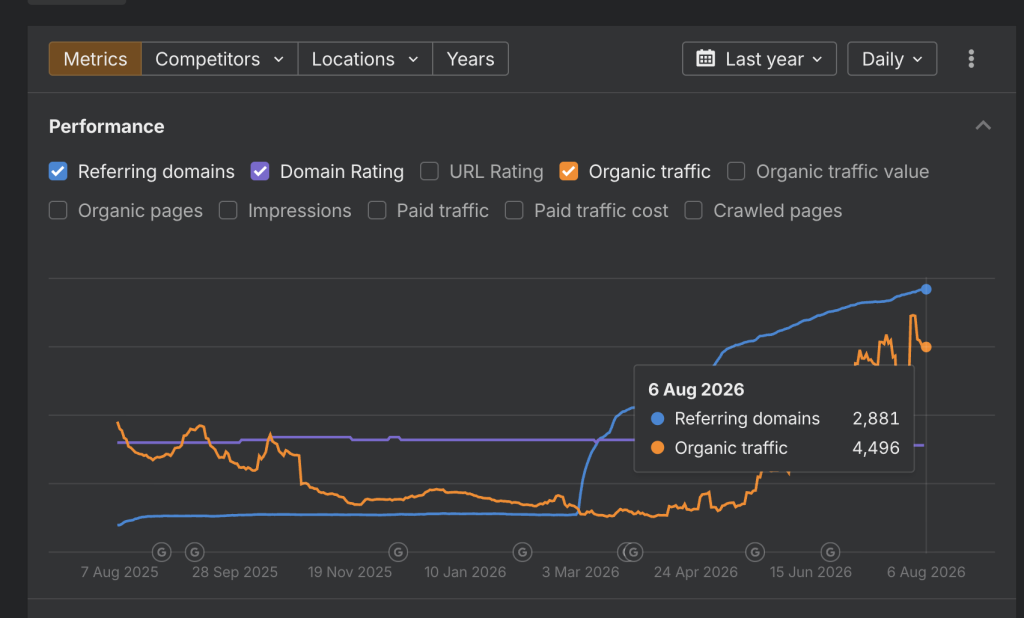
The chart tells this story better than any summary, because the two lines move in sequence rather than together:
- Through late 2025 and January, both lines are flat or falling. No links, no growth.
- In early March, weeks into the campaign, the referring-domains line turns sharply upward.
- Traffic does nothing for several more weeks. Then, in April, it turns, and climbs steeply into the summer.
Links first, traffic after, separated by the lag it takes Google to recrawl, re-evaluate, and re-rank. On most campaigns, the connection between links and growth is an argument. Here it is visible.
SEO Growth
- Organic Traffic: around 4,500 per month, up from 1,061. A 324% increase in six months.
- Referring Domains: around 2,880, up from roughly 410.
- Backlinks: 14,600, up 13,400.
- Domain Rating (DR): steady around 40 throughout, which is the point: the growth came from relevance and authority, not from inflating a vanity metric.
AI Search Visibility
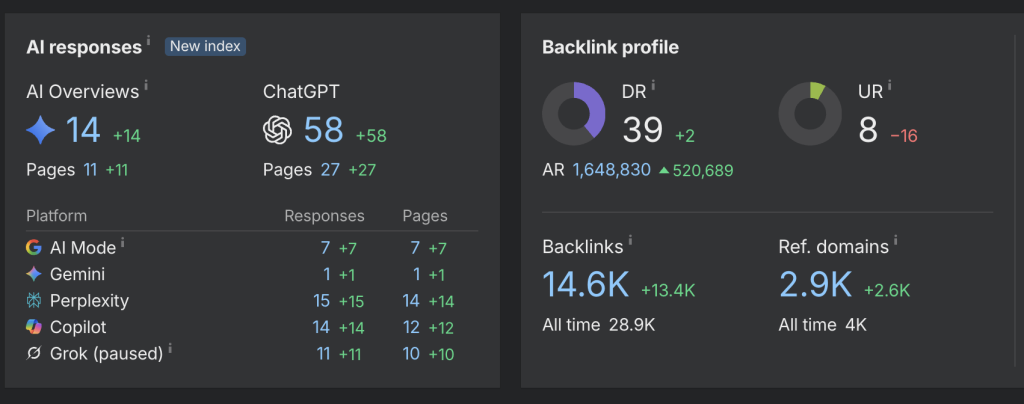
Even in a niche AI systems handle cautiously, the brand now appears across the major assistants:
| Platform | Responses |
|---|---|
| ChatGPT | 58 |
| Perplexity | 15 |
| Copilot | 14 |
| AI Overviews | 14 |
| Grok | 11 |
| Google AI Mode | 7 |
| Gemini | 1 |
ChatGPT alone cites the brand 58 times across 27 pages. For a restricted category, earning any AI citations is an achievement; the trust signals that convinced editors to cover the brand are the same ones AI systems look for when choosing sources.
Why This Worked
Scarcity cut both ways. The same caution that makes publishers reluctant to cover regulated products means almost no brand in the niche has real editorial coverage. So when this one earned it, there was no crowd to disappear into. Thirty-five legitimate placements stood out to search engines the way three hundred would in a saturated market.
The efficiency shows up in the arithmetic: roughly 3,400 new monthly visits from 35 links is about 100 visits gained per link, and traffic that compounds where a paid channel would need continuous spend to sustain.
Key Takeaway
More links is not always the answer. In restricted niches, the winning move is a small number of links your competitors cannot get at all.
Six months, a Starter Package, strict compliance limits, 35 editorial links, and a 324% lift in organic traffic. If your business sits in a niche most agencies say is too hard, that difficulty is not the obstacle. It is the moat.
Real editorial links, from real publications. No PBNs, no shortcuts.