

Overview
This case study looks at how SimplyMedia helped an established medical equipment brand break out of a year-long traffic decline, more than double its organic traffic in 10 months, lift its Domain Rating from 44 to 53, and build a major presence across every AI search platform, including more than 1,200 citations in Google AI Overviews.
The two-year chart tells the story plainly. Traffic had been sliding for a full year before the campaign began. Within a few months of kickoff, the decline bottomed out. Ten months later, traffic sits at an all-time high on the chart, at more than double the starting level.
To protect client confidentiality, private identifiers (including the exact domain) have been removed. All metrics reflect real performance tracked using industry-standard SEO tools.
Client Snapshot
- Industry: Medical Equipment (e-commerce)
- Engagement Start: October 2025
- Service: HARO Link Building and journalist-led Digital PR
- Package Size: Pro Package
- Primary Goal: Reverse the traffic decline and build durable search and AI visibility
Starting Point (October 2025)
The brand had a real product, a solid site, and a serious problem. Organic traffic had been declining for about a year, and in a healthcare-adjacent niche, that kind of slide compounds: fewer rankings mean fewer trust signals, which mean fewer rankings.
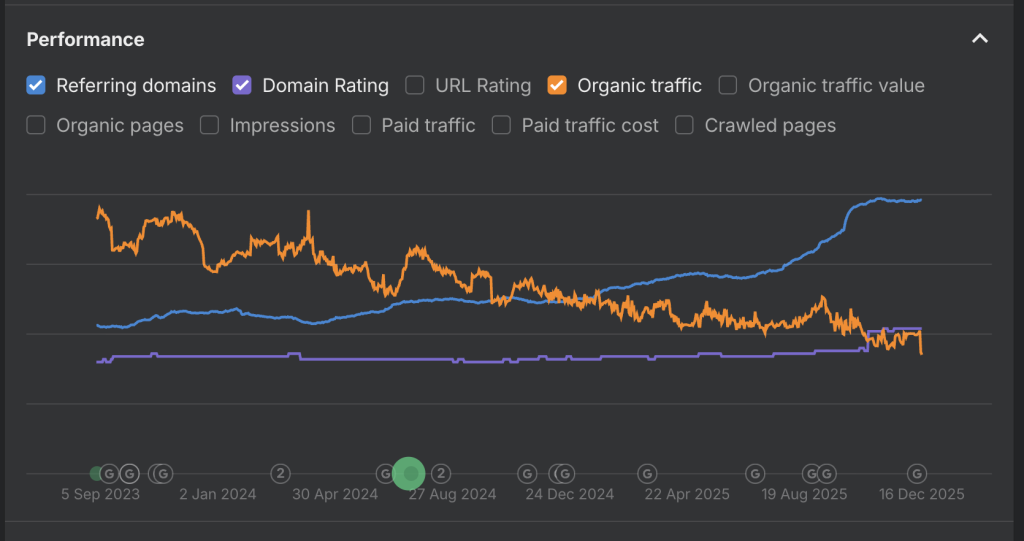
- Industry: 10,279 per month, down from earlier highs
- Domain Rating (DR): 44
- Referring Domains: around 1,300
- AI Search Presence: minimal across the newly tracked AI platform
SimplyMedia Strategy
Healthcare-adjacent niches are among the hardest to earn links in. Publications are cautious about health topics, so generic outreach goes nowhere. The way in is genuine expertise.
The Challenge
To turn the trend around, the brand needed authority signals strong enough to convince Google, and now AI systems, that it deserved to outrank bigger medical retailers. That meant editorial coverage in real publications, anchored in the health, home, family, and lifestyle conversations its buyers actually read, and supplemented with high-authority opportunities beyond the immediate niche when the publication was strong enough to justify it.
What We Did
- Earned editorial links through HARO and our own journalist connections
- Positioned the brand’s leadership as expert sources on home care, senior health, sleep, and family wellbeing topics
- Anchored the campaign in relevant health, home, and lifestyle coverage, while also taking shoulder-niche opportunities in business and marketing publications when the authority on offer was too strong to pass up
- Built links at a steady pace across the full 10 months so authority compounded naturally
Links Built
We landed 276 editorial links and brand mentions over the campaign. Those came from a smaller set of core features and expert quotes, pitched and placed at a steady monthly rhythm with no bursts, which syndication then multiplied several times over. That consistency matters: a smooth velocity curve looks natural to Google, and it means authority compounds instead of spiking and stalling.
Editorial coverage at this level multiplies itself. One expert feature through Real Simple, for example, was republished across Yahoo editions worldwide, MSN, and AOL. That syndication effect is why the brand’s profile grew by roughly 1,000 referring domains and 6,900 backlinks over the same period, several times the number of placements we made directly.
Anatomy of One Placement
To show what the syndication effect actually looks like, here is one placement from this campaign, traced end to end.
We secured a single expert feature through Real Simple, a lifestyle publication with a large syndication network. That one quote was then republished across the Real Simple content network and its syndication partners:
- Real Simple (original placement)
- MSN
- NewsBreak
- Yahoo, across 8 international editions (US, UK, Australia, Canada, Hong Kong, Taiwan, Singapore, Malaysia)
- AOL, across 4 editions (US, UK, Germany, Canada)
One pitch. One quote. Roughly 15 live URLs across three continents, each one a brand mention or link from a trusted media network. This is how a steady rhythm of core features became 276 landed links and mentions, and roughly 1,000 new referring domains: strong editorial coverage multiplies itself in ways paid links never do.
Notable Placements
- Forbes
- The Seattle Times
- The Washington Times
- Reader’s Digest
- Real Simple
- Daily Mail
- Family Handyman
- Drug Topics
- Bored Panda
- The Mercury News
- Yahoo
- MSN
- AOL
- ValiantCEO
Results (August 2026)
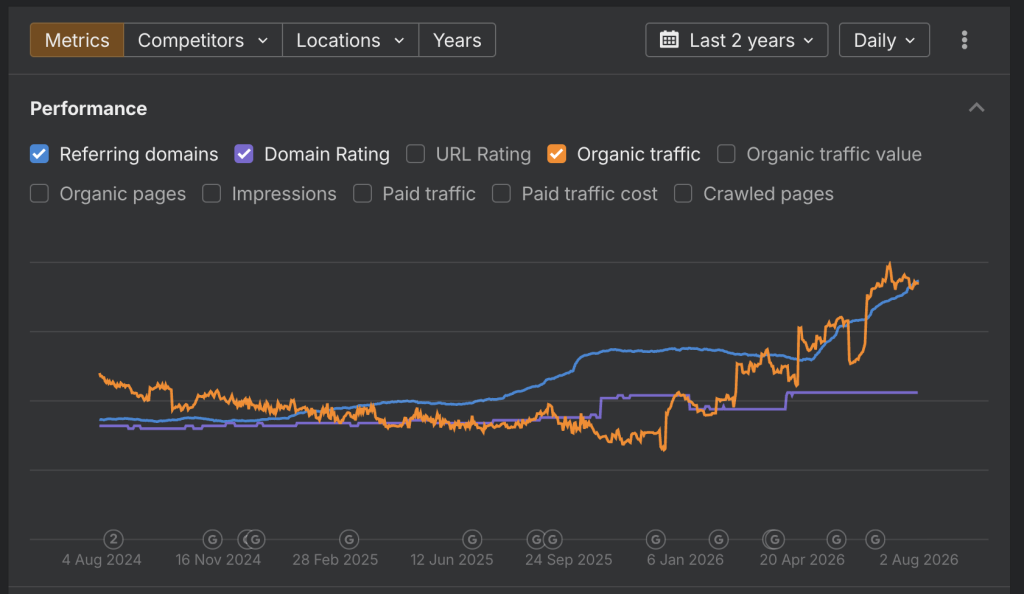
Ten months in, every core metric is at or near its high on the chart.
SEO Growth
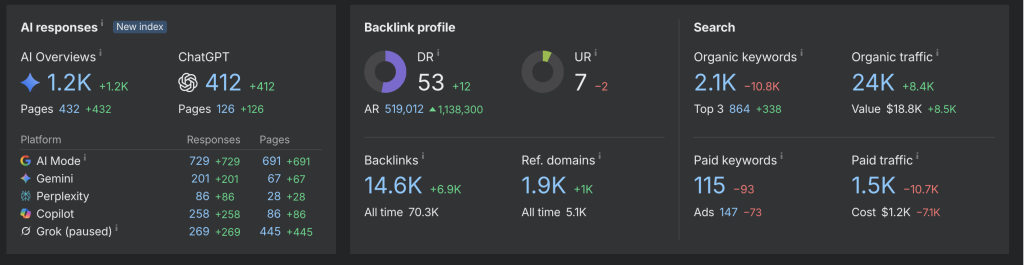
- Organic Traffic: around 24,000 per month, up from 10,279. That is a 133% increase, more than double, and it reversed a year-long decline.
- Domain Rating (DR): 53, up from 44.
- Referring Domains: around 1,900, up roughly 1,000.
- Backlinks: 14,600, up 6,900.
- Top 3 Rankings: 864 keywords now sit in the top 3 positions, up 338.
- Traffic Value: about $18,800 per month, up roughly $8,500, an 82% increase in the equivalent ad spend the brand would otherwise need to buy these clicks.
AI Search Visibility
The brand now has one of the larger AI search footprints we track, from a minimal starting presence:
| Platform | Responses |
|---|---|
| AI Overviews | 1,200+ |
| Google AI Mode | 729 |
| ChatGPT | 412 |
| Grok | 269 |
| Copilot | 258 |
| Gemini | 201 |
| Perplexity | 86 |
Those AI Overview citations span more than 400 pages of the brand’s content, and the pattern in which pages get cited is worth noting. AI assistants overwhelmingly cite the brand’s informational content, its guides and expert answers, rather than product pages. That informational trust then feeds the commercial side: the product pages convert the demand the cited content earns. It is also why domain-wide editorial authority beats exact-match links pointed at product pages. Health and care purchases are exactly the kind of research-heavy decisions people now bring to AI assistants, and this brand is in those answers.
Why This Worked
In a cautious, health-adjacent niche, editorial links do the one thing volume tactics cannot: they establish the brand as a source publications and AI systems are willing to trust. The core of the campaign reinforced topical relevance in health, home, and family coverage, while selective shoulder-niche placements in business and marketing publications added raw authority on top. Not every link needs to be perfectly on-niche to move the needle. When the publication is strong, a great link is a great link, and the mix of deep relevance plus broad authority is what compounds. The syndication effect then multiplied every win.
The chart is the proof. A full year of decline, then referring domains, Domain Rating, and traffic turning upward together within weeks of the campaign starting, and climbing for ten straight months since.
Is Your Traffic Decline a Link Problem? A 10-Minute Self-Check
If your own chart looks like this brand’s did a year ago, three questions will tell you most of what you need to know:
- Has your referring-domain growth flatlined?
Open your backlink tool and look at the referring domains line for the past 12 months. If it is flat while your traffic falls, your authority has stopped growing while your competitors’ has not. That was exactly this brand’s situation in October. - Are your recent links actually relevant?
Look at your last 20 new referring domains. If most of them have nothing to do with your niche, they are not building the topical authority Google and AI systems reward. - Do you appear in AI answers for your money queries?
Ask ChatGPT and Google’s AI Mode the questions your buyers ask. If your competitors are cited and you are not, that gap is now costing you the fastest-growing slice of search.
If you answered yes, no, and no, you are looking at the same problem this brand had, and the same playbook applies.
Key Takeaway
A traffic decline is not a verdict. It is a signal that a site’s authority has stopped growing while its competitors’ has not.
In 10 months on our Pro Package, this brand went from a year-long slide to an all-time traffic high: organic traffic up 133%, DR up 9 points, 338 new top-3 positions, and more than 1,200 AI Overview citations. Real editorial links, from real publications. No PBNs, no shortcuts.